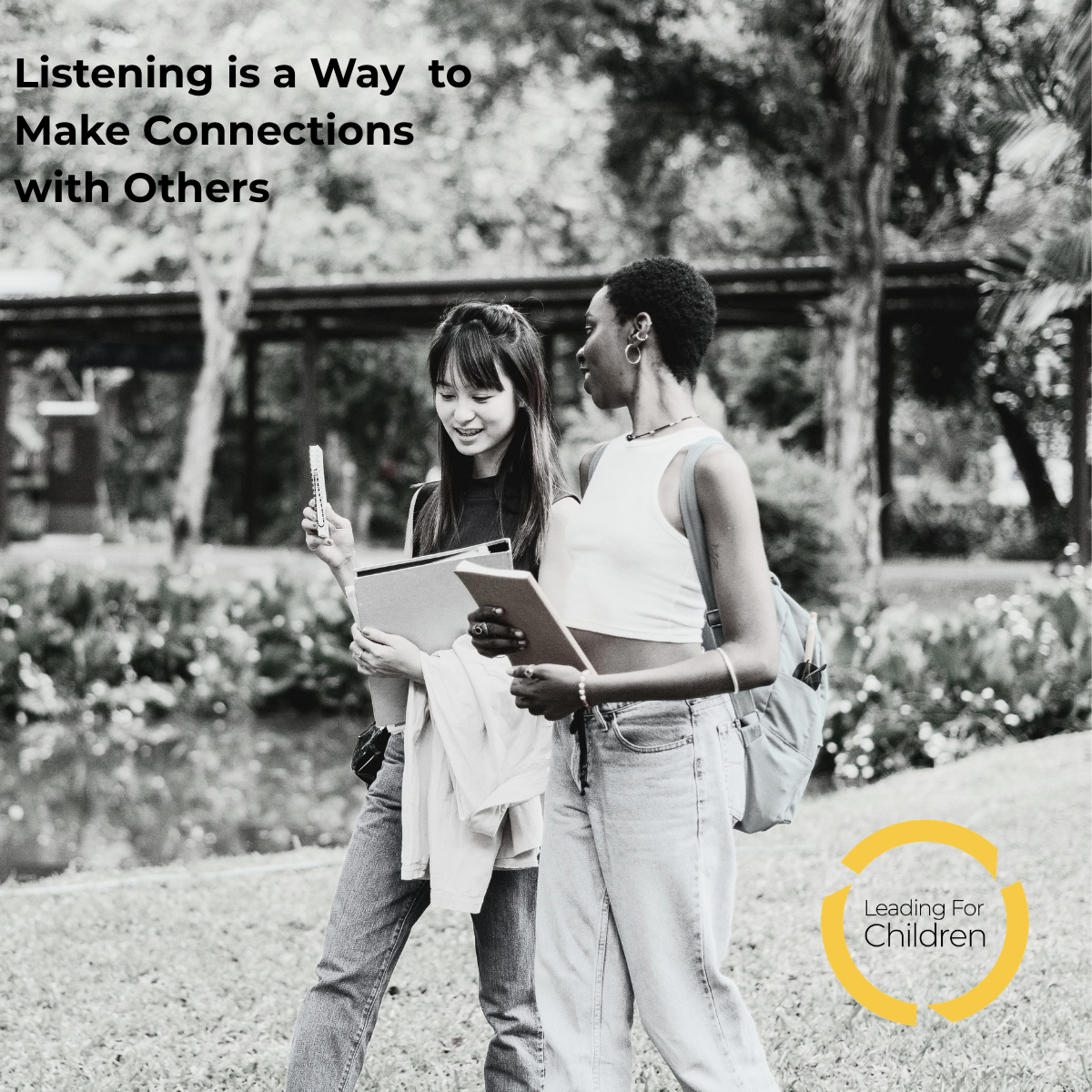
Every instant is a moment of hearing, whether we want to or not. We take in the cacophony of the world – an upset child, a motorcycle, a breeze in the trees. Our thoughts and feelings are jolted by that child’s scream or soothed by the rustle of the leaves, or we sense the motorcycle’s acceleration in our bodies, usually without us even being aware. Hearing can be tiring or confusing or even exhilarating. Always though, it happens to us.
I’ve come to understand listening as something different. With practice, I can shift some moments towards when I am present and tuned in, when I am curious, when I hear not just another’s voice but their intent and fears and hopes, when listening is an act of respect and an opportunity for growth. There’s a great deal of noise in the world and many moments in a day so I’m likely to do a lot of hearing and probably less listening. But when I am able to step into that listening space, I think my conversation partner and I do a bit to bring into being the world we hope for.
Like with so much else, I’ve found that true listening begins with deliberately deciding to, that is, setting and acting with intention. Sometimes there’s a little internal monologue. “So my sister is waiting for me in the living room. She’s carrying so much right now. When I go back in with our coffee, I want to listen with my full, caring attention.”
And ah, intentions can so easily get swept away. So, once again like with so much else, I’m discovering that mindfulness, the practice of noticing my thoughts and feelings while I’m in the middle of them, helps keep me oriented towards my intention. Like “Oh darn, there goes the dog to bark at the mail carrier! Ooooh….there goes my attention. Bring myself back.” Or “Wow I am SO frustrated with her holding all this back from other people that I think need to know. Slow breath. Come back to curiosity. Let go of judgement.”
For me, this full presence has always been easier with children than with adults. As an early childhood educator it is absolutely muscle memory to get down low, relax my face, tune in to the child’s body, voice tone, rhythm, emotions, silences and probably so much else that I’m not even consciously aware of, and listen generously. How can I join this child and listen in a way that gives them back the message that I see them, respect them, value them, that they can trust me, that they are safe with me?
I’ve found that a couple of my daily rituals serve as moments of practice for listening with adults. When I wake in the morning, I take a few moments to sit and just listen. To my body, my thoughts, my feelings. Just notice what shows up. Maybe write it down, maybe reflect on it. Mostly just notice. If there were muscles for intention and mindfulness, I’d be exercising them. I suppose it’s neural pathways? Anyway, that ritual of intentionally slowing down, tuning in, being curious about, respectful and compassionate towards myself, seems to have aided me in entering that state when I’m with others.
I do something somewhat similar at the end of the day. I pause and reflect on the day, calling to mind and heart moments I am grateful for. The stranger who said she liked my shirt, my mother bringing my attention to the clouds in the sky, the squirrel eyeing me curiously from the trunk of the tree, the colleague who listened when I went off-topic and talked about something I was going through that was difficult. My sense is that this habit of bringing these moments to mind at the end of the day is changing how I listen during the day. I think I’m more likely to notice and respond to the hope tucked in someone’s story or the delight in their eyes because I’m looking for it.
One of the gifts of being part of the communities around Leading for Children has been to have a community of practice for learning this full-hearted listening with adults, with early educators and administrators, coaches and families. Together we listen in carousel and hold space for each other. Listening with this intention, mindfulness, respect, and curiosity, our mutual learning communities become spaces where we feel seen and safe. We can find our internal and external voices, can sit with feelings, clarify thoughts, and explore memories that might have been obscured or muddled. Along the way, we strengthen ourselves individually, weave a tapestry of connections, and nurture our community.
I think this highlights what a powerful and even creative act listening is. So what is it that I hope to evoke, to welcome into this space with my listening? When I am listening to someone who is not used to being heard, can I listen so as to reflect the power of their voice back to them? When I am with an administrator who is angry with me, what do I want to illuminate? Do I respond to their hostility? or the pain? or fear? Or maybe to the flicker of hope that I think I see she is trying to keep lit back behind all that? When I am with someone who is dear to me who is telling me something that is hard to hear, what do I open for growth, or healing, or perhaps grieving? And sometimes hardest of all, when I am listening to my unkind inner voices, can I be as generous with myself as I am trying to be with others?
Perhaps we can listen to hear the world we hope to give birth to.
How to Listen
Listening is a form of worship,
but you don’t have to kneel
on the floor with folded hands
or mouth the perfect prayer.
Just open the door of yourself
to another, become the space
they step through to show you
who they are. This is holiness:
two people seated together
on the pew of a park bench,
at the altar of a kitchen table.
Even if no one says a word
for a while, receive the silence
until it’s like a new language
only the two of you can speak.
James Crews